Early signs of ALS can appear subtly and recognizing them could signal something serious: amyotrophic lateral sclerosis (ALS). This progressive disease affects nerve cells that control muscles, and recognizing its early signs can make a significant difference in managing its impact.
ALS United Ohio, a key resource for Cincinnatians, emphasizes the importance of awareness through resources like their article “Face ALS Symptoms: Identifying the Signs of ALS“. This piece explores ALS symptoms, the value of early detection, diagnosis methods, and local support options in Cincinnati. By understanding these, you can help spread awareness and aid early intervention.
What is ALS and Why Awareness Starts Local
ALS is a neurodegenerative disorder that targets motor neurons; the cells in your brain and spinal cord that send signals to muscles for voluntary movements. When these neurons degenerate, muscles weaken, leading to challenges with walking, speaking, swallowing, and eventually breathing. According to the Mayo Clinic, ALS affects about 30,000 people in the United States at any given time, often striking those over 60, though it can occur earlier.
In Ohio, the prevalence mirrors national trends, with environmental and genetic factors potentially playing a role. Early awareness is crucial for all Cincinnatians because early spotting can connect individuals to local resources faster.
ALS United Ohio serves the Greater Cincinnati, offering free care services to 587 people last year alone. Their mission focuses on providing multidisciplinary support, funding research, and advocating for better outcomes. But it all begins with recognizing the early signs of ALS.
Recognizing Early Signs of ALS: Everyday Clues
Early signs of ALS are often subtle and can mimic other conditions, making awareness essential. Symptoms vary by onset type: limb-onset (about 74% of cases) or bulbar-onset (one-third of cases).
For limb-onset ALS
Look for muscle weakness and fatigue starting in arms or legs. This might appear as difficulty gripping a steering wheel or stumbling on uneven paths. Other early signs of ALS include involuntary muscle twitching (fasciculations) in the arms, legs, shoulders, or tongue; cramps that disrupt sleep; and stiffness from spasticity due to upper motor neuron damage. Fine motor issues, like trouble buttoning a shirt are common too.
Bulbar-onset ALS
Affects speech and swallowing first. Early signs of ALS here include slurred, hoarse, or nasal speech, making conversations challenging. Difficulty swallowing could lead to choking on food or fluids regurgitating through the nose, increasing risks like aspiration pneumonia. Facial muscle weakness might show as a weak, twitching tongue or drooling (sialorrhea), affecting about half of patients. Changes in facial expressions or emotional recognition, like trouble identifying disgust or surprise, can impact social interactions.
Other Early Signs of ALS from the Mayo Clinic
Tripping and falling, hand clumsiness, untimely laughing or yawning, and thinking or behavioral changes. Muscle cramps and stiff muscles are also noted, often without initial pain. Respiratory changes, like shortness of breath during a light jog, may emerge later but underscore the need for vigilance.
These symptoms progress gradually, but early recognition allows for timely medical evaluation. If you notice these early signs of ALS in yourself or a loved one, consult a healthcare provider immediately.
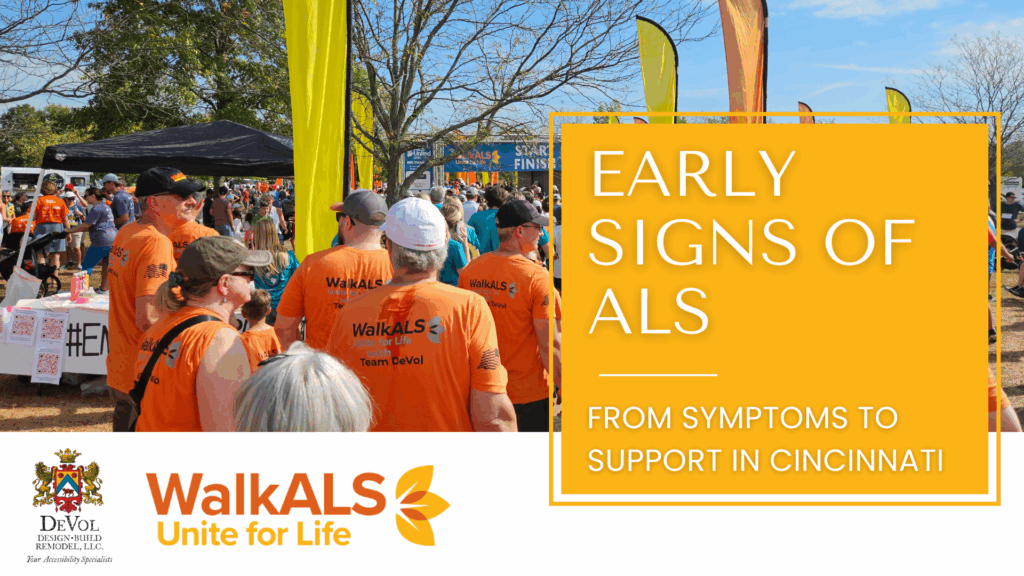
To support awareness efforts in Cincinnati, donate to ALS United Ohio fundraising efforts in our 10th year of support for the WalkALS event. Your contribution funds much needed support for patients and families affected by ALS, as all community education webinars and resources for our community .
Early Signs of ALS are Critical for Getting Care
Early detection of ALS isn’t just about diagnosis—it’s about improving quality of life and outcomes. As highlighted by the Centers for Disease Control and Prevention (CDC) in biomarker studies identifying early signs of ALS in its initial stages enables timely interventions that can slow progression.
For instance, early access to medications like riluzole or edaravone can extend survival by months, according to a review in PMC. Without spotting early signs of ALS, symptoms worsen unchecked, leading to faster dependency on assistive devices or respiratory support.
In Cincinnati, early detection connects individuals to specialized care sooner, reducing complications like malnutrition from swallowing issues or falls from weakness. Research shows that multidisciplinary care, starting early, can enhance mental health and extend life expectancy. ALS United Ohio stresses this in their symptoms guide, noting that tools like kinematic analysis of jaw movements (87% accuracy) or video-based facial assessments (96.1% accuracy) can detect bulbar decline before full symptoms appear. These methods highlight how awareness leads to proactive testing.
Genetic factors add urgency: About 10-20% of ALS cases are familial, per Mayo Clinic, and early genetic testing can identify risks. Programs like PREVENT ALL ALS at Ohio State University Wexner Medical Center target at-risk individuals, offering counseling and monitoring. For Cincinnatians, this means better preparation and access to trials that could halt progression.
The Diagnosis Process: From Suspicion to Confirmation
Diagnosing ALS involves ruling out other conditions through a thorough process. It starts with a clinical exam and patient history, assessing muscle strength, reflexes, and coordination. Neurologists look for early signs of ALS like atrophy, fasciculations, or spasticity.
Key tests include electromyography (EMG) and nerve conduction studies, which detect lower motor neuron damage by recording muscle electrical activity. These confirm denervation in multiple regions. Genetic testing, recommended for 20% of cases with known genes like SOD1 or C9orf72.
In Cincinnati, the University of Cincinnati ALS Multidisciplinary Clinic at Daniel Drake Center offers comprehensive evaluations. Ohio State’s Healey ALS Platform Trial tests treatments, emphasizing early enrollment.
Local Support in Cincinnati: Resources and Pathways
Once early signs of ALS are spotted, Cincinnati offers robust support through ALS United Ohio. Their multidisciplinary approach involves neurologists, therapists, and nutritionists for symptom management. Free services include the Medical Equipment Program, providing wheelchairs and communication devices.
Support groups in Cincinnati help with emotional challenges like depression (9-12% clinically) and anxiety (8-88%). Respiratory therapies, like BiPAP, and nutritional support via feeding tubes are available early. The UC ALS Clinic (phone: 513-475-8730) integrates these, while Ohio State’s NRI-BBB biorepository collects samples for research.
Taking Action: Decide Your Role in the Fight Against ALS
Spotting early signs of ALS in Cincinnati saves lives by enabling swift access to care and research. ALS United Ohio’s resources, like their symptoms articles, empower our community.
For a stronger impact, joining us or financially supporting our fundraising at the Cincinnati Walk ALS event on September 28, 2025, at Winton Woods Park.
Your gift funds life-changing services!
From webinars to genetic testing to the care for hundreds in Ohioans. Every dollar brings us closer to early detection breakthroughs. Be the change Cincinnati needs. Choose to donate or walk with us to help end ALS!